Stalking the Large Trout of Australia
Tasmania the southern most island
state of Australia is the premiere fly fishing destination.
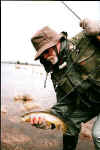 There
are several features that make the trout fishing in Tasmania a unique fly
fishing experience. Above all else is the tremendous stalking and sight
fishing that’s available on many of the Central Highland Lakes. All
trout in Tasmania are totally wild, you do not encounter ‘stock fish’
so the angler has to match his wits with the wary trout. The fish are very
cunning, for the average angler they are often very difficult to catch and
sometimes down right impossible! But it is this ‘visible’ challenge of
fishing the shallow, clear Tasmanian lakes that makes the journey a viable
proposition.
There
are several features that make the trout fishing in Tasmania a unique fly
fishing experience. Above all else is the tremendous stalking and sight
fishing that’s available on many of the Central Highland Lakes. All
trout in Tasmania are totally wild, you do not encounter ‘stock fish’
so the angler has to match his wits with the wary trout. The fish are very
cunning, for the average angler they are often very difficult to catch and
sometimes down right impossible! But it is this ‘visible’ challenge of
fishing the shallow, clear Tasmanian lakes that makes the journey a viable
proposition.
Shore Fishing
There are some local words and local
techniques that are synonymous with Tasmanian fly-fishing.
‘Polaroiding’ is the technique of
choice and ‘tailing trout’ is a local phenomenon. So what is
polaroiding? Well it is not unlike searching the salt flats for Bones, the
angler wades shallow sandy flats searching for underwater clues that give
away the fishes presence. The first step to polaroiding in fresh water is
to acquire a pair of amber/ brown polarized glasses and make sure you are
wearing a hat that shades your eyes. By slowly wading the angler scans the
water column both horizontally and vertically for anything that may
resemble a fish. It is very important to focus your vision below the
water, ignoring everything above the surface plane. Shape is the primary
clue that often reveals a fish. The form of a trout or profile is very
different to other sub surface objects such as rocks or weed beds.
Movement is the other key visual clue, and most trout encountered will
show some signs of movement. It may be the dark shadow of the trout
reflected of the silt bottom, maybe the golden flanks as a fish turns to
intercept its prey, or it may just be flicker of the tail that gives the
fish away. Colour is less dependable as fish are naturally camouflaged to
suit their environment. However contrast can sometimes be to our advantage
and this is most evident when brown trout are cruising over shallow weed
beds or rainbow trout are cruising near the surface in deep clear water.
 Tailing
is a term that many devoted salt flats fishermen will certainly
understand. Brown trout in Tasmania just like bone fish in the Florida
Keys feed in very shallow or ’skinny water’. The behavior is
associated with disturbed or ‘nervous water’ which is the visual clue
to the fishes presence. Fishing for large tailing brown trout is EXTREME
fly-fishing! Little Pine Lagoon is well recognized as one of the premiere
lakes in Tasmania to find tailing fish. The fish are always most active
early and late in the day when the sun is low, but overcast days will
allow the angler to search for ‘tails’ most of the day. There are some
lakes in Tasmania where the angler can stalk tailing fish all season long,
however the behavior is most obvious in spring (September to November)
Tailing
is a term that many devoted salt flats fishermen will certainly
understand. Brown trout in Tasmania just like bone fish in the Florida
Keys feed in very shallow or ’skinny water’. The behavior is
associated with disturbed or ‘nervous water’ which is the visual clue
to the fishes presence. Fishing for large tailing brown trout is EXTREME
fly-fishing! Little Pine Lagoon is well recognized as one of the premiere
lakes in Tasmania to find tailing fish. The fish are always most active
early and late in the day when the sun is low, but overcast days will
allow the angler to search for ‘tails’ most of the day. There are some
lakes in Tasmania where the angler can stalk tailing fish all season long,
however the behavior is most obvious in spring (September to November)
What clients find really exciting is
combining polaroiding with tailing fish, but you need steady nerves and
accurate short casts. Imagine wading down a grassy flat mid morning, sun
at your back, clear sky, and seeing large brown trout clearly visible and
actively feeding in less than 12 inches of water. If the angler is
fortunate enough to hook a tailing trout, he will soon discover how these
strong fish can unload a full fly line in a single run.
Boat Fishing
The ecology of the Tasmanian lakes,
there abundant trout, and their shallow nature make them perfect boat
fisheries. The variety and potential of boat fishing in Tasmania is
enormous, with the boat being primarily used as a platform for polaroiding,
a taxi to reach distant shores, or as a vehicle to chase surface feeding
fish. Guides use boats to access areas of minimal fishing pressure and it
provides a means to quickly move from one productive area to another.
‘Loch style fishing’ is one of
the more popular and is definitely the most productive and consistent
method of catching trout in Tasmania. The technique takes place from a
broadside drifting boat and involves the retrieval of a team of flies
through the surface of the water in attempt to induce a take from a nearby
trout. This type of fishing was born in Scotland and Ireland where it was
practiced on the larger lochs for wild brown trout and sea trout.
Originally the style consisted of repeated short casts (6 to 10m) downwind
from a drifting boat. Each cast the angler would sweep the rod back and up
into the air as a team of flies were drawn, skated, and then
"dibbled" back to the boat. The technique was essentially
rhythmic and unhurried, and was very effective on trout feeding in or near
the surface.
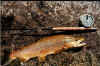 Probably
the most challenging but definitely the most rewarding boat fly-fishing is
associated with ‘wind lanes’. Wind lanes are defined pathways on lakes
where food collects, often characterized by a smooth ribbon of water
running down an otherwise rippled surface. They are similar to the seams
or bubble lines in a stream, where food is channeled by the combination of
currents and wind. The best lanes normally contain the most food and
consequently the most feeding trout. Trout in lanes feed with reckless
abandon, and when a good lane is found there will often be dozens of
snouts punching through the surface film. The hungry rainbow trout often
feed in schools, like playful dolphins they glide in and out of the water.
Tails, fins and dark wide backs are visible as the trout rise at regular
intervals. These rainbows feed quickly and present very demanding and
challenging targets. There is no greater thrill than hooking a large
rainbow in deep water! But you must be good in the casting department.
This is one form of fishing where picking up and casting a long line is of
paramount importance. Reading the speed of fish is an acquired skill that
must be matched by an accurate cast. Wind lane fishing is highly dependant
on overnight midge hatches, and since midges hatch all year round,
drifting down a lane early morning is always a possibility!
Probably
the most challenging but definitely the most rewarding boat fly-fishing is
associated with ‘wind lanes’. Wind lanes are defined pathways on lakes
where food collects, often characterized by a smooth ribbon of water
running down an otherwise rippled surface. They are similar to the seams
or bubble lines in a stream, where food is channeled by the combination of
currents and wind. The best lanes normally contain the most food and
consequently the most feeding trout. Trout in lanes feed with reckless
abandon, and when a good lane is found there will often be dozens of
snouts punching through the surface film. The hungry rainbow trout often
feed in schools, like playful dolphins they glide in and out of the water.
Tails, fins and dark wide backs are visible as the trout rise at regular
intervals. These rainbows feed quickly and present very demanding and
challenging targets. There is no greater thrill than hooking a large
rainbow in deep water! But you must be good in the casting department.
This is one form of fishing where picking up and casting a long line is of
paramount importance. Reading the speed of fish is an acquired skill that
must be matched by an accurate cast. Wind lane fishing is highly dependant
on overnight midge hatches, and since midges hatch all year round,
drifting down a lane early morning is always a possibility!
Wilderness Fishing
 Tasmania
has a vast wilderness fishery collectively described as the ‘Western
lakes.’ The region offers anglers the best opportunity to stalk and land
wild trophy size browns in shallow lakes that are rarely fished. This
backcountry wilderness fishery contains over three thousand lakes and
tarns amidst spectacular National Park and World Heritage land. Anglers
are rare in this fishing adventure wonderland! Most lakes are accessible
by foot only, all are very shallow, clear, and populated by brown trout,
that range from two to ten pounds and bigger! The feature fishing of the
area is the polaroiding on clear sunny summer days. The fish are easy to
see in these shallow clear waters, at times fish are visible as far away
as fifty meters. Fish often cruise the edges, so the angler must move
slowly, stay low and stalk his fish. Fishing is difficult and the angler
must be good at short, delicate, quick casts. But he must be equally good
at quickly punching out a long line when the situation arises, and be ‘well
versed’ at spotting fish. A final word of warning is not to venture too
far into this wild area without being accompanied by an experienced person
or guide. The weather changes very quickly, and loosing your bearings in
the open flat terrain can become a high possibility.
Tasmania
has a vast wilderness fishery collectively described as the ‘Western
lakes.’ The region offers anglers the best opportunity to stalk and land
wild trophy size browns in shallow lakes that are rarely fished. This
backcountry wilderness fishery contains over three thousand lakes and
tarns amidst spectacular National Park and World Heritage land. Anglers
are rare in this fishing adventure wonderland! Most lakes are accessible
by foot only, all are very shallow, clear, and populated by brown trout,
that range from two to ten pounds and bigger! The feature fishing of the
area is the polaroiding on clear sunny summer days. The fish are easy to
see in these shallow clear waters, at times fish are visible as far away
as fifty meters. Fish often cruise the edges, so the angler must move
slowly, stay low and stalk his fish. Fishing is difficult and the angler
must be good at short, delicate, quick casts. But he must be equally good
at quickly punching out a long line when the situation arises, and be ‘well
versed’ at spotting fish. A final word of warning is not to venture too
far into this wild area without being accompanied by an experienced person
or guide. The weather changes very quickly, and loosing your bearings in
the open flat terrain can become a high possibility.
 The
best time to plan the trip is October to March. Quanta’s Airways
provides excellent service with flights connect from either Sydney or
Melbourne. Tasmania’s best fisheries are located in the Central
Highlands. This region encompasses central Tasmania and the small country
town of Miena situated on the shores of the Great Lake is the most central
location for the angler. The Central Highlands Lodge in Miena is the
finest fishing lodge in the area, and a number of guides provide services
to the lodge, myself included.
The
best time to plan the trip is October to March. Quanta’s Airways
provides excellent service with flights connect from either Sydney or
Melbourne. Tasmania’s best fisheries are located in the Central
Highlands. This region encompasses central Tasmania and the small country
town of Miena situated on the shores of the Great Lake is the most central
location for the angler. The Central Highlands Lodge in Miena is the
finest fishing lodge in the area, and a number of guides provide services
to the lodge, myself included.
A good source on the web for further
information about Tasmanian fly-fishing is the Fishing Tasmania www.fishingtasmania.com
web site. And one of the best books for some pre – trip reading is Greg
French’s 1994 book Tasmanian Trout Waters. The book contains maps
and information on all inland lakes, rivers, and lagoons.
Tasmania is a special place. It’s
relative isolation, friendly people, disease free status, and cunning wild
fish must be experienced. Make it your next fishing destination and join
me on one of the shallow lake flats!


